Compact Mixed-Use Residential Development
with Ross Woolley
Architect of Record: RNAW Architects
Hopewell, New Jersey
Design Development
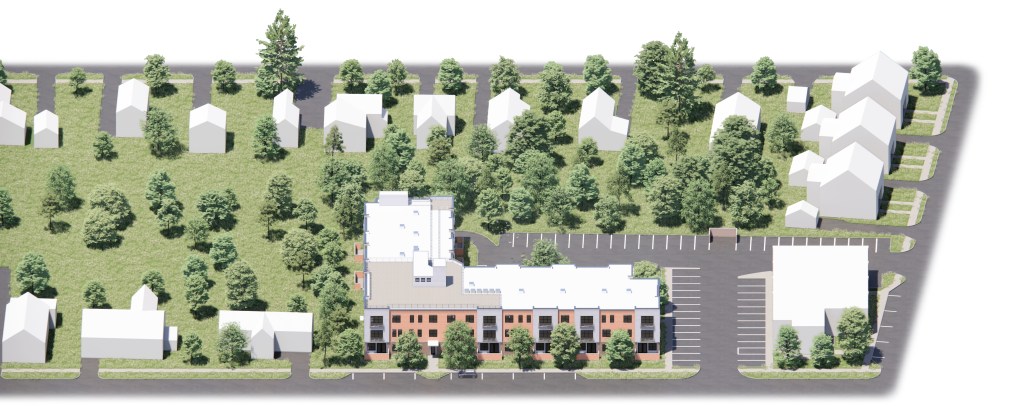
Oblique Axonometric Rendering [Neighborhood Block, Aerial View]
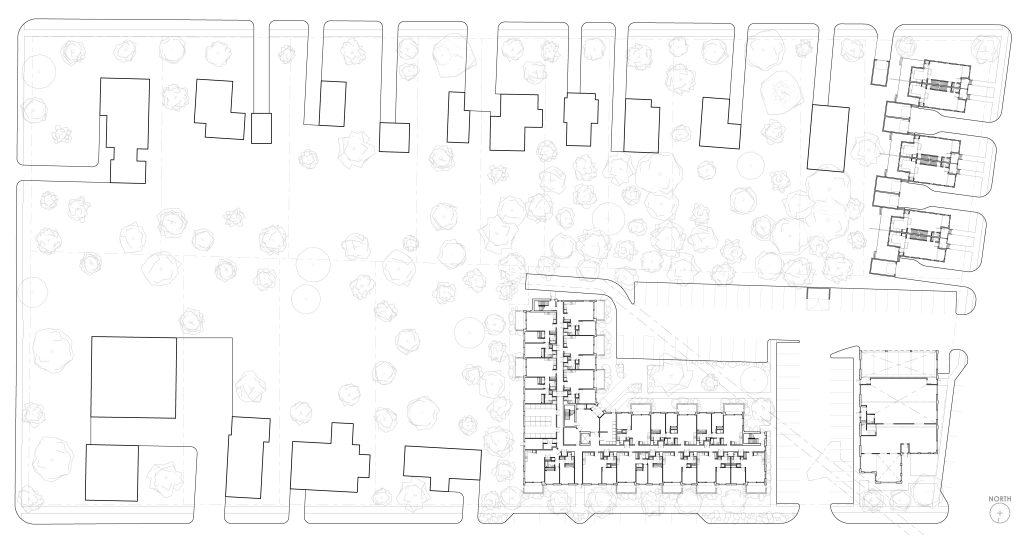
Site Plan [Neighborhood Block, Ground Floors]
A private client’s mixed-use residential development with new apartment building, duplex row, and renovated office space, sited within an upper-middle class suburban locale. The design for the apartment building is highlighted herein.
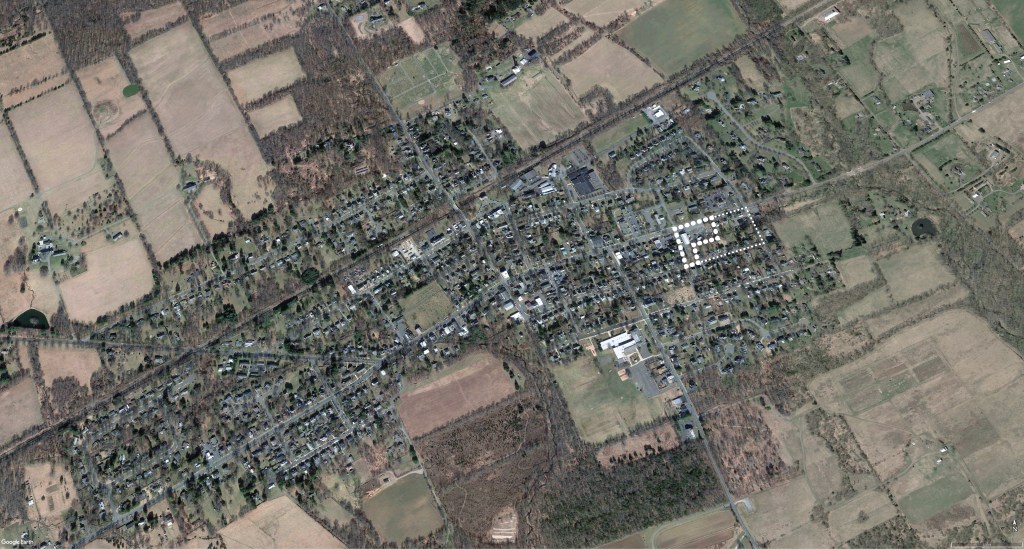
Site Aerial [Town and surrounding farmland, via Google Earth]
The project is grounded in a sensitivity to its context. The founding of Hopewell Township in 1748 predates the formation of the United States. As such, the town is layered in history, and predisposed to a hesitance towards change. The town’s fabric epitomizes an idyllic vision of suburbia, sprawled with single-family residences, often centenarian in age, and replete with stereotypical white picket fences and yards of lush, well-manicured, and water-hungry bluegrass.
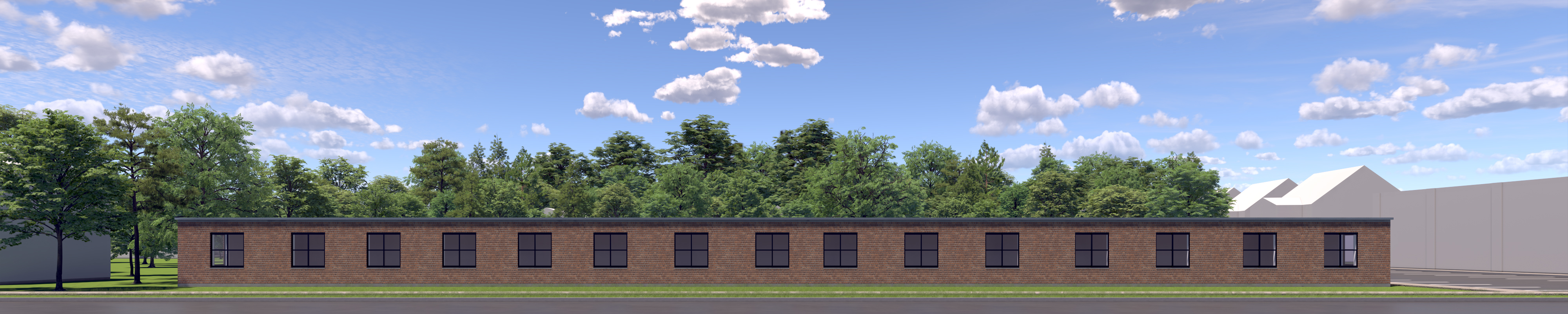
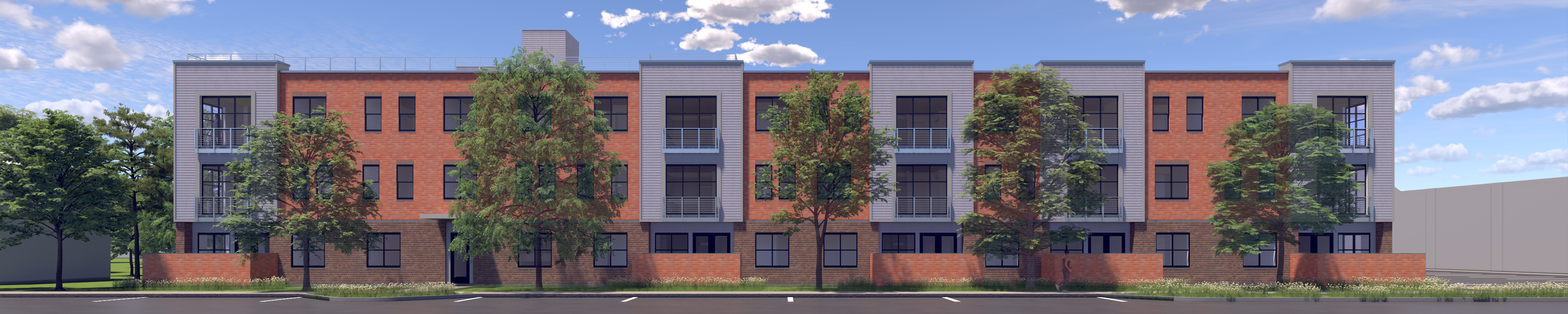
Perspective Rendering [False Palimpsest]
In order to accommodate this conservative context, the project of the apartment building performs a kind of act of camouflage: its design attempts to obscure both its large scale, and its newness. As with almost all works of built architecture, it’s a juggling act between the expectations of the client (and their financier), the town (and both its residential constituents and governing bodies), and the constraints and particularities of the site. An anecdote of this negotiation: in the early planning phases of the project, the varying stakeholders’ respective calculations demanded quite a wide range in the number of residential units necessary to make the apartment building viable: The financial institution backing the project expected a number of units close to three figures, while the town’s planning board initially endorsed the project with the caveat that it would max out at a number of units in the teens. (The project’s final incarnation met somewhere in the middle.)
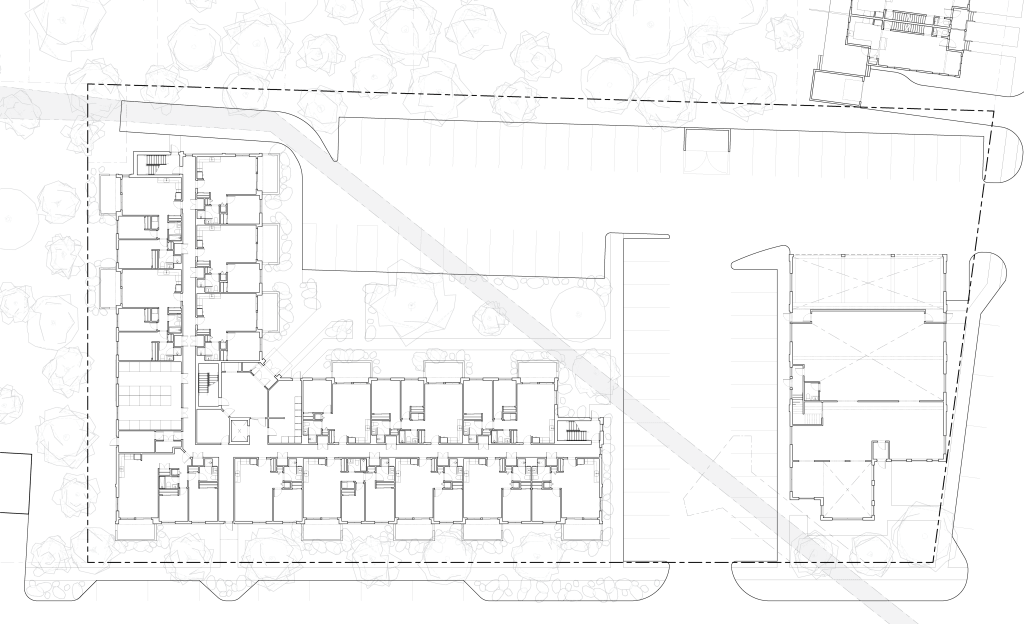
Site Plan [Underground Waterway,Ground Floors]
Meanwhile, the underground waterway cutting diagonally across the site (highlighted in grey above) severely limits the footprint of the building, and the site’s zoning limits the maximum height of the building. The apartment building’s L-shaped plan carefully avoids the underground waterway.

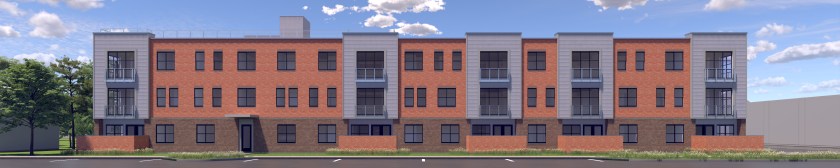
Perspective Rendering [North Elevation, E. Broad St.]
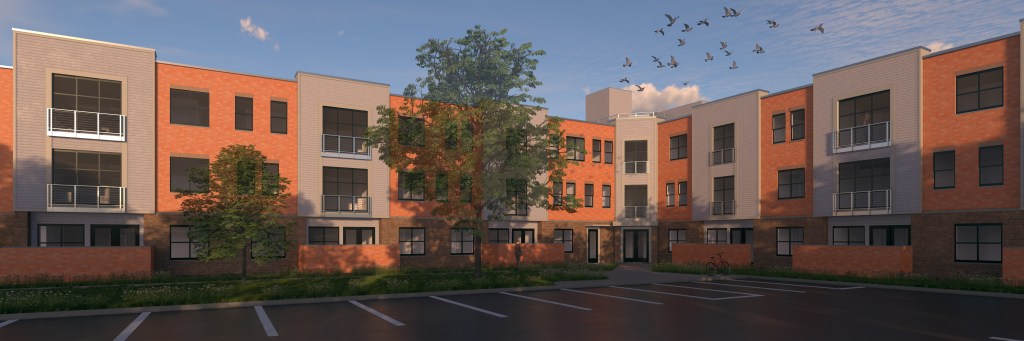
The three-story, 44-unit apartment building synthesizes two competing local aesthetics: (1) the conventional residential vernacular of horizontal vinyl or fiber cement siding and Hardie trim, and (2) the renovated industrial brick style of the few larger buildings in the town. The building’s façade is clad with reclaimed brown bricks on the ground floor, and a lighter thin-brick veneer on the floors above.
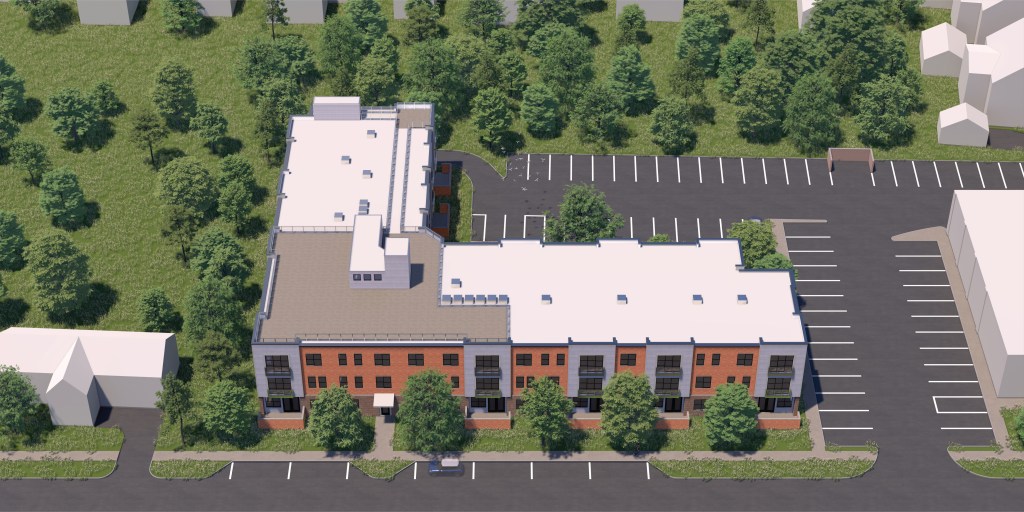
Perspective Rendering [Aerial View]
Tiled portions of the flat roof serve as an outdoor lounge deck and lookout.
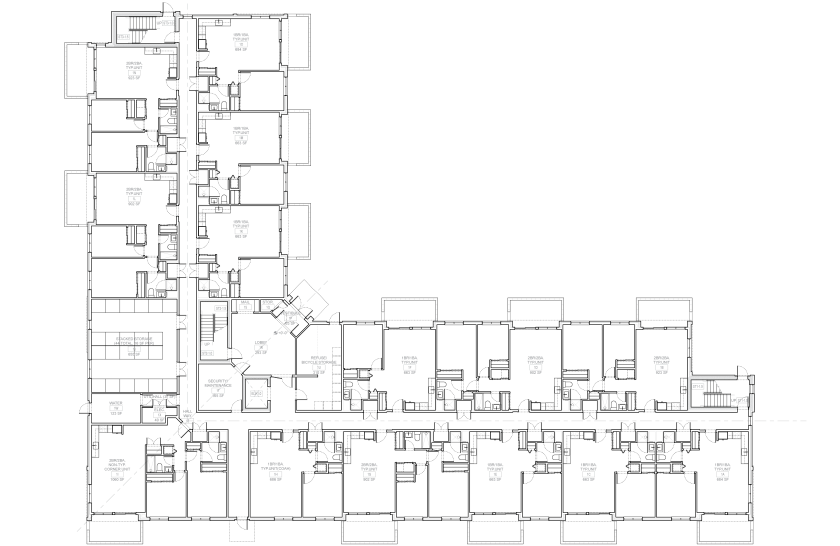
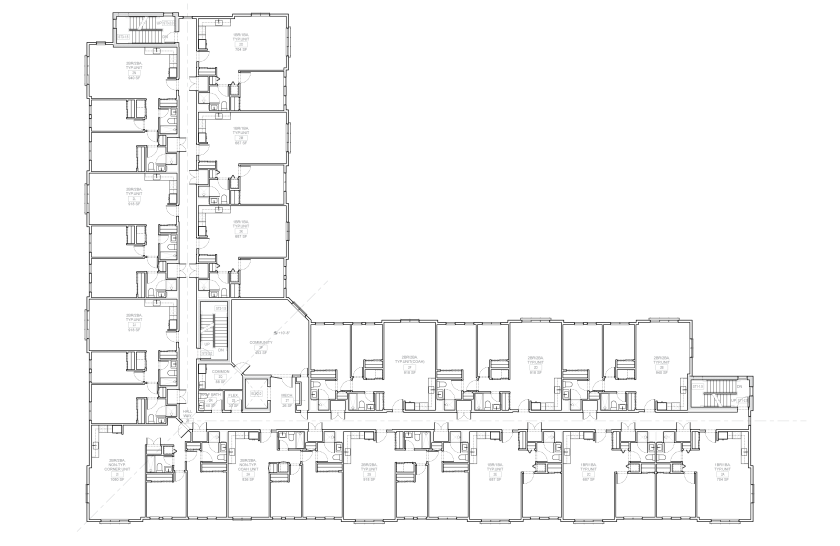
Plans [Ground Floor // Second Floor]
At the living space of each ground floor apartment unit, a modest exterior terrace is enclosed by a low wall. There is a lobby-lounge space on every floor, with a shared kitchenette and half-bath on each of the upper floors, and bike storage plus additional tenant storage closets on the ground floor.
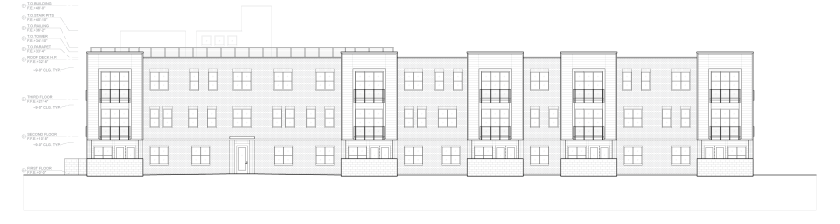
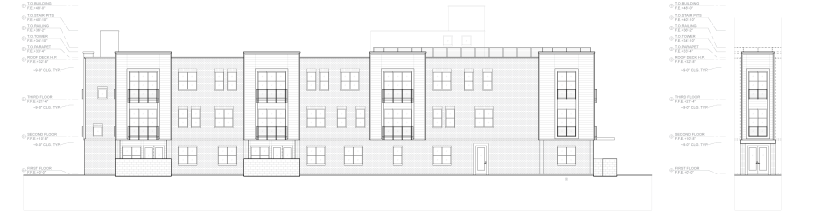
Elevations [North // East // Southwest Entrance]
At the stacked living spaces of the upper floors, the exterior wall jogs to protrude small fiber cement-clad vertical towers that fragment the building’s horizontality.

Perspective Rendering [Block Elevation, E. Broad St.]
This volumetric fragmentation attempts to respectfully acclimate the relatively large building into the context of a town composed almost exclusively of single-family residences.

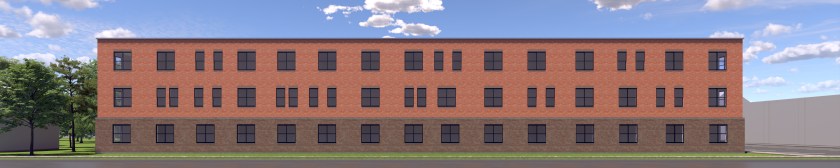
Perspective Renderings [False Palimpsest]
This fragmentative layering extends further into the composition of the building’s façade: the faded and weathered reclaimed bricks of the ground floor juxtapose with the crisp and new thin-brick veneer cladding system of the floors above. The overall façade composition evokes a kind of false palimpsest that mimics a series of phases of construction and renovation over time, rather than a new build. One might imagine this fictional narrative starting with a single story brick warehouse, which then expanded in height at some point to accommodate more warehouse floors, to a more recent intervention that inserted the “Hardie towers” and low-walled patios to interrupt a previously continuous monolith.
[The variation of brick is also a product of the project’s material and economic exigencies. The thin-brick veneer available within the project’s budget cannot continuously span the full height of the building, and the recycled solid bricks are only cost-effective up to a single story in height.]

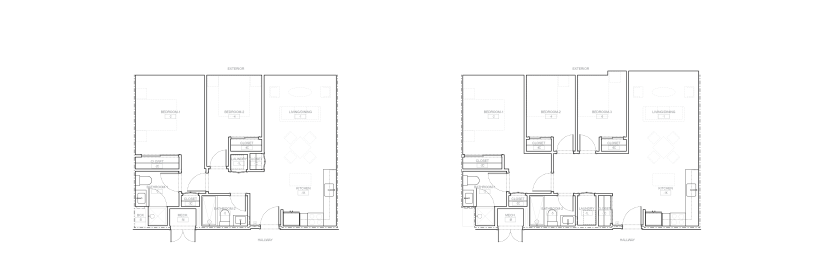
Unit Plans [Typical Apartments]
Negotiating the aforementioned requirements of the client, the financier, the township, and its residents, the apartment units are modest in size but carefully planned, with an emphasis on material and spatial sensitivity, clean construction, and above all, meaningful habitation for the occupant — our foremost constituent. The apartments consist of one-bed/one-bath, two-bed/two-bath, and three-bedroom/two-bathroom units, with a washer-dryer closet in every unit.
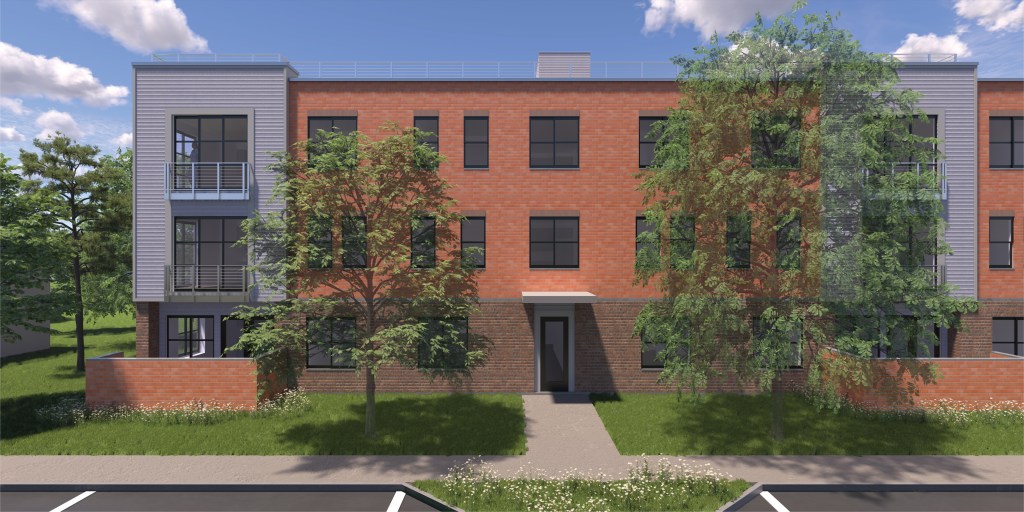
Perspective Rendering [North Elevation Detail]
Each living space is lit by large operable windows with industrial steel Juliet balconies at the upper floors. The semi-random placement of windows along the brick façades of the bedroom spaces produces a condition where almost every unit is unique, in spite of the consistent internal logic of their plans.
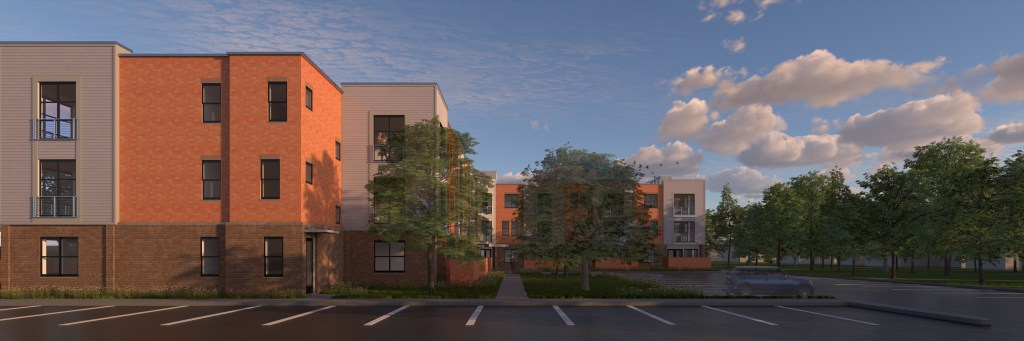
Perspective Rendering [West Elevation, Mid-summer sunset]
Perspective Rendering [Southwest Entrance Elevation, Mid-summer sunset]
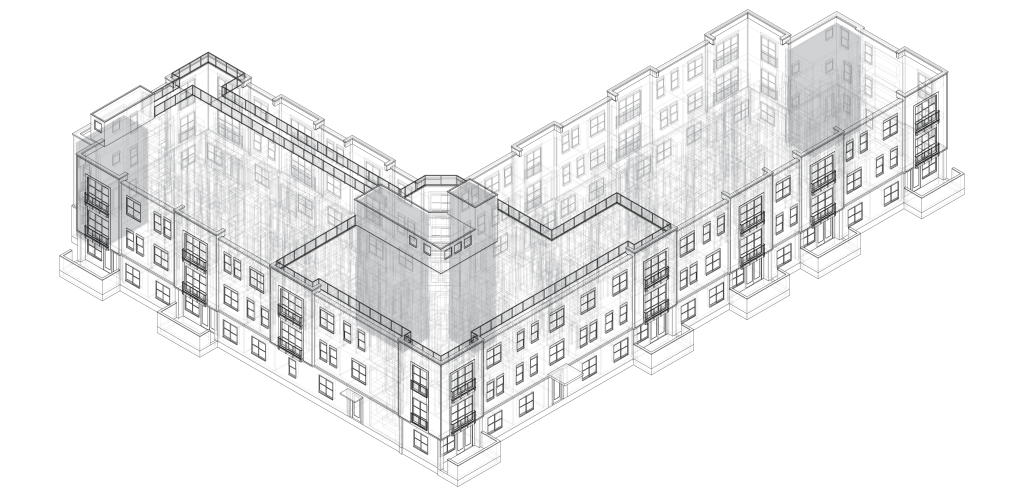
Isometric [Building]
Targeting a scant construction budget of less than $125 per square foot (in pre-2020s-inflation dollars), the building is erected using wood frame platform construction with concrete masonry elevator pit and stairwells (highlighted in grey above).
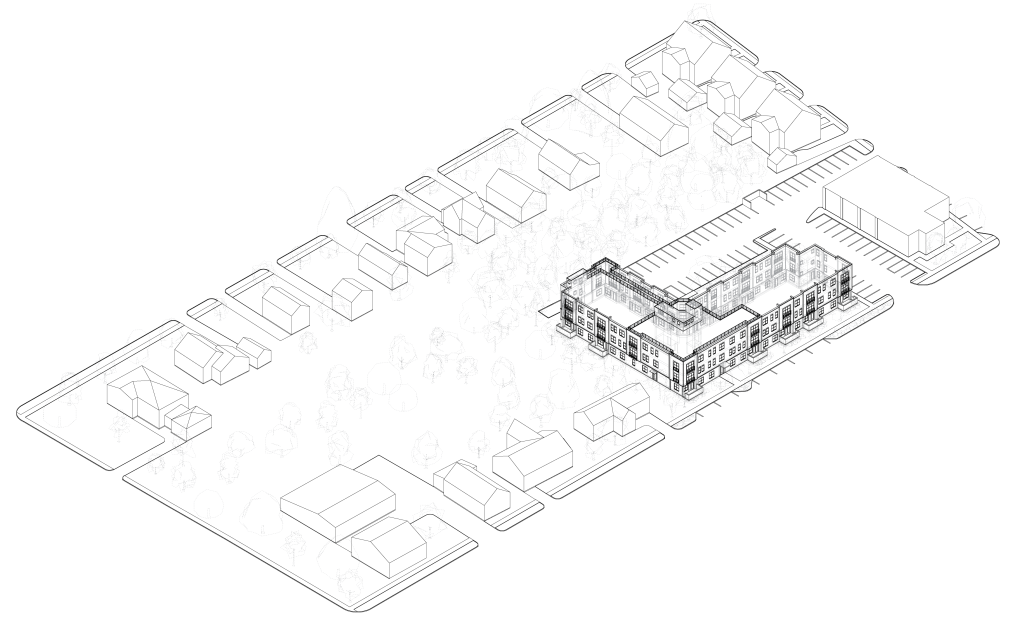
Isometric [Neighborhood Block]
After receiving approval from the township’s Historic Preservation Commission, this project was paused by the client due to the global events of 2020. The project was intended to be one of the few — if not the first — multi-unit residential developments in a town crowded with single-family dwellings. The 44-unit building would have 69 bedrooms to comfortably house more than 115 people, on a site that might otherwise be zoned for four single-family residences that would house — accounting generously — twenty total people. This would’ve been an almost six-fold increase in the housing capacity of the site, and within a borough with a population of 1,918 per the 2020 US Census data, this project could generate an almost 6 percent population increase.
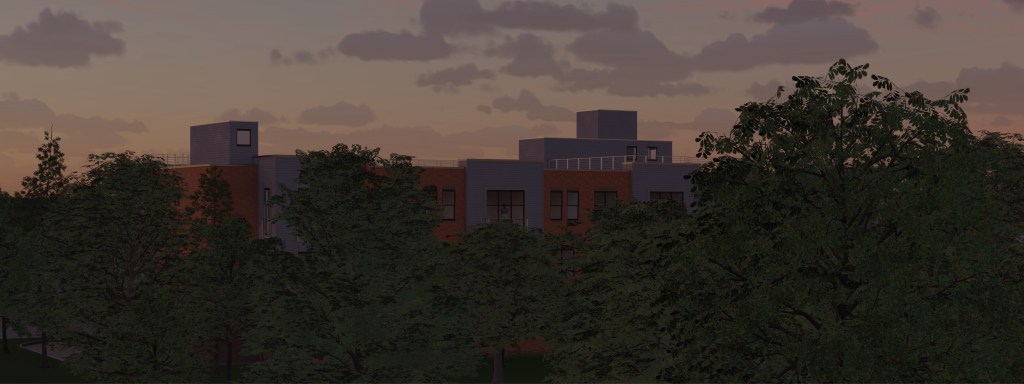
Perspective Rendering [Nosy Neighbor View, Mid-summer dusk]
The design of the project anticipated this disruption, and in order to sensitively situate the building within its context with minimal controversy, the building is an unabashed pastiche. We imagine a nosy neighbor — a longtime resident returning from snowbirding in their Florida house for a prolonged period (not uncommon for upper-middle class New Jersey-based retirees), during which time the apartment building has arisen — driving by the project and doing a double take, unsure if their memory is at fault. It is a chameleon that tip-toed into the town, and pretends that it’s always been there.
PROJECTS: ABODE // CABIN // SEMI-SUB-URBAN // STATION // GREEN // TRANSPOSITORY // TEA-CRETE // LIGHTS // PENDANT // RINGS // NEO-CAIRNS // THESES: METAMATERIALISM (Human Being) // POST-MORDIAL (MIT SMArchS) // ISOTOPIA (Syracuse BArch) // HUMANS: KRIS // JODY
© Human Being Design 2025
 HUMAN BEING DESIGN