Collapsing Binary Conditions
A Statement of Vision
Ongoing

Our design ethos is shaped on a metamaterialistA framework, in which material entities are inextricable from corollary structures, systems, and forces, and in a state of continuous reciprocal dialogue. A metamaterialist model collapses binary oppositions into interdependent, inseparable, and unified vectors: human and environment, being and design, mind and body, living and nonliving, subject and object, digital and physical, bit and atom, information and medium, meaning and form, cause and effect — each must be understood in congenital relation to the other.B These pairs are not merely two sides of the same coin, but rather interconnected webs within amorphous spheres. And to carry the metaphor forward, these spheres have completely porous, nebulous, and almost undefinable outer membranes overlapping with and interpenetrating and fluctuating with each other. This model departs from modernity’s project of anthropocentric alienation, which elevated the human from the nonhuman, and consequently, further estranged the human from the fellow human. The bifurcation of human from environment and the partitioning of the human between the realms of the ideal and the real has produced multifaceted repercussions of detachment and estrangement that have contributed to so many of our current crises: of climate, of ecology, of health, of inequality, of wellbeing, of empathy…C
As individuals grown within this binary paradigm; marinated in this ontic stew of indoctrination; floating within an osmotic ocean of hyper-normalized polarity and contradiction; we’ve found ourselves apprehensively straddling two concurrent — and sometimes divergent — domains:
- (X) We have a desire to engage in conventional projects for a working class clientele. Our architectural practice centers on modest, thoughtful housing and communal spaces for both the masses and the marginalized, with an emphasis on material and spatial sensitivity, clean construction, and above all, meaningful habitation for the occupant — our foremost constituent.
- (Y) We have an interest in — and passion for — experimental, avant garde, and sometimes esoteric subject matter that could potentially be obtuse, uninteresting, or alienating to a mainstream audience. Our design research is focused on novel means of anthropomorphic form-making, fabrication, and materiality, using fundamentally human tools, methods, and sources to explore, subvert, or dissolve the Enlightenment-era bifurcation between human and environment.
As we strive to reconcile these contradictions, to shed our bifocalized lenses and seek the full spectrum of color, and furthermore, matters, energies, and forces — akin to the “Replicants” of Blade RunnerD — we search for subjective first principles:
- (X+Y) Both avenues of inquiry — research and practice — investigate modes of identity expression, material embodiment, and cultural reflection, and share the tenet that every human is deserving of both personal space and public expression.E
Taking a step back for a moment to reflect, these complexities and contradictions seem almost fundamental to the human experience: who among us doesn’t have some kind of appreciation for both classical and contemporary art, or both popular and underground music, or both clean and vulgar humor? Who among us is a truly “good” or “bad” person? While we might be conditioned towards stereotyping and diminishing and one-dimensionalizing ourselves and others, we all contain multitudes — as do all things. And so as we’ve come to a place in our own work where we’re probing these contradictions, both contemporaneously and retrospectively: not only seeing (X) in (Y) and (Y) in (X) to varying degrees, but also seeking to understand and situate our projects within the larger umbrella of this metamaterialist framework. Some instances in which our work explores, subverts, or dissolves traditionally binary classifications to embody non-dualist conditions include:
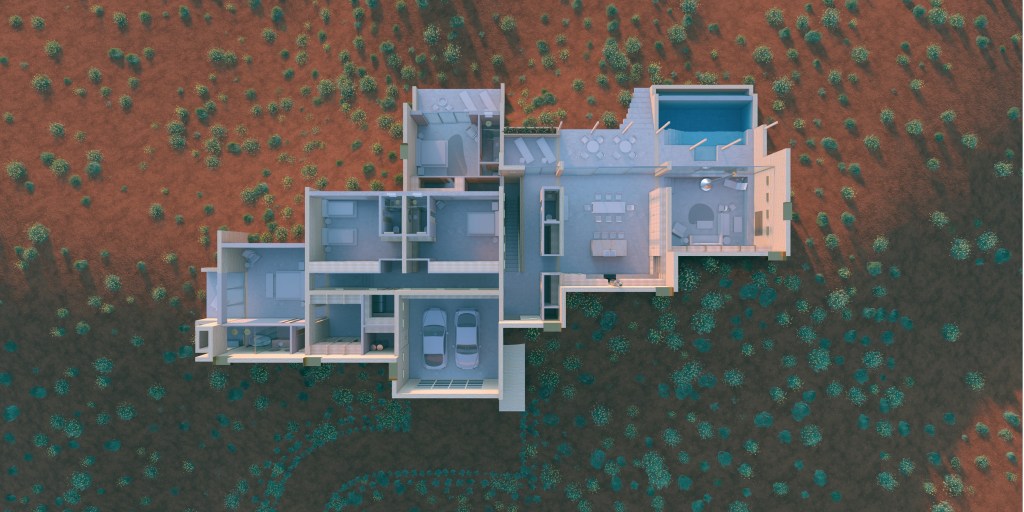
- The potential for rammed earth construction to blur the boundary between building and landscape, as well as the elusive demarcation between particulate and aggregate within this material system. (See: Abode.)
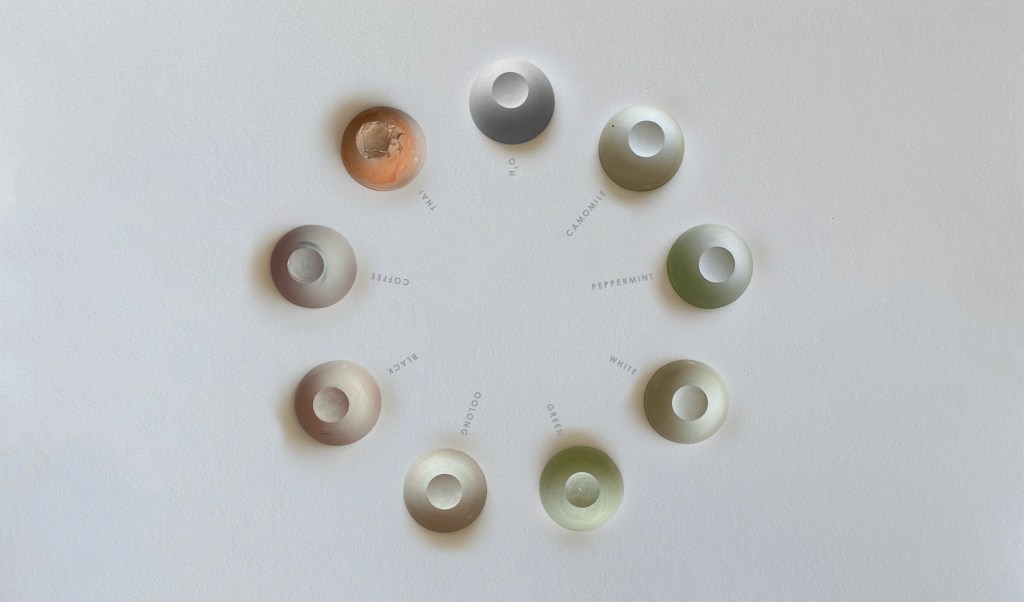
- The deliberate amalgamation of tea and concrete, seemingly incongruous anthropogenic materials, with countervailant relationships to the conventional membrane of the human body and its inside versus outside, i.e. ingestible (tea) versus envelope (concrete). (See: Tea-Crete.)
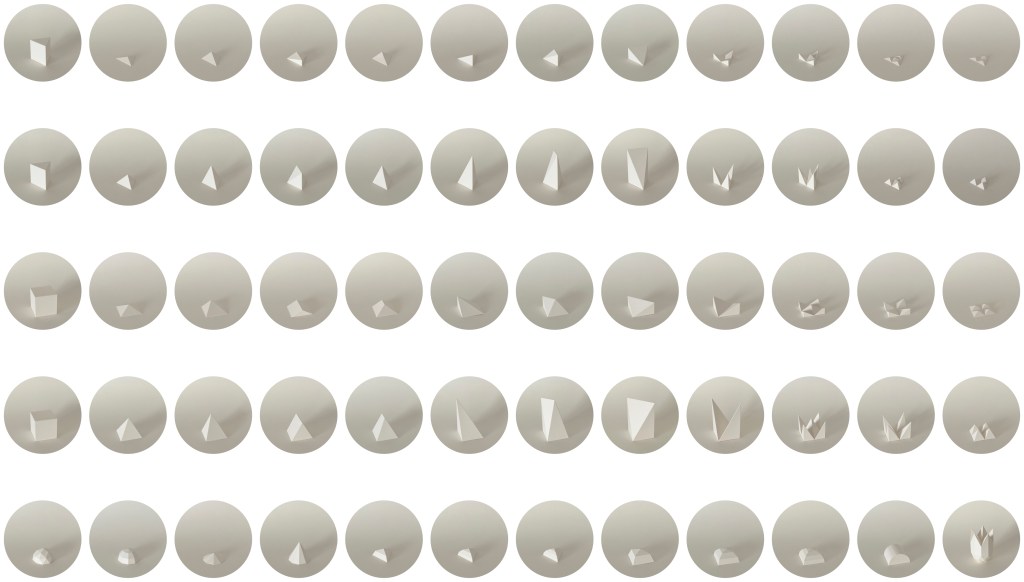
- The fluctuating perceptual boundary between shape and figure in a morphological series of Euclidean paper models. (See: Lights.)
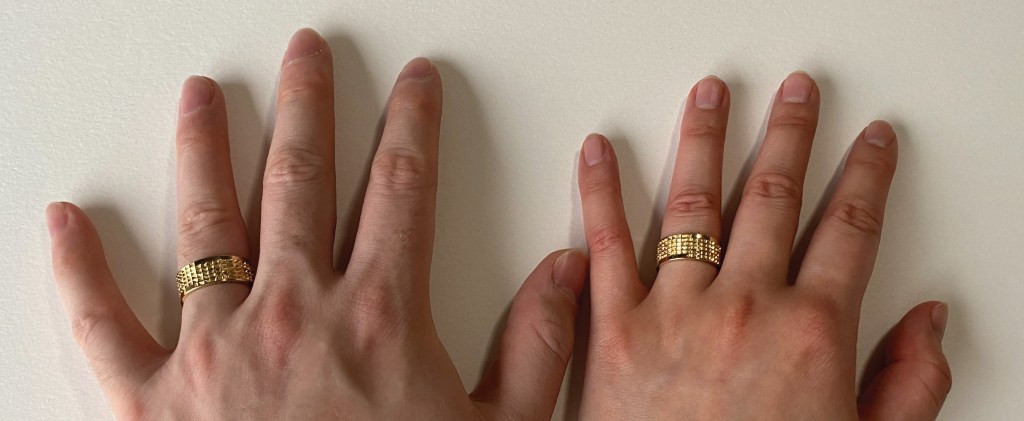
- The externalization of the informatic structure of otherwise internalized human biomatter onto the bodily accessory of a ring, and the pairing of this genetic information with the double helix’s complementary strand on the ring of another human. (See: Rings.)
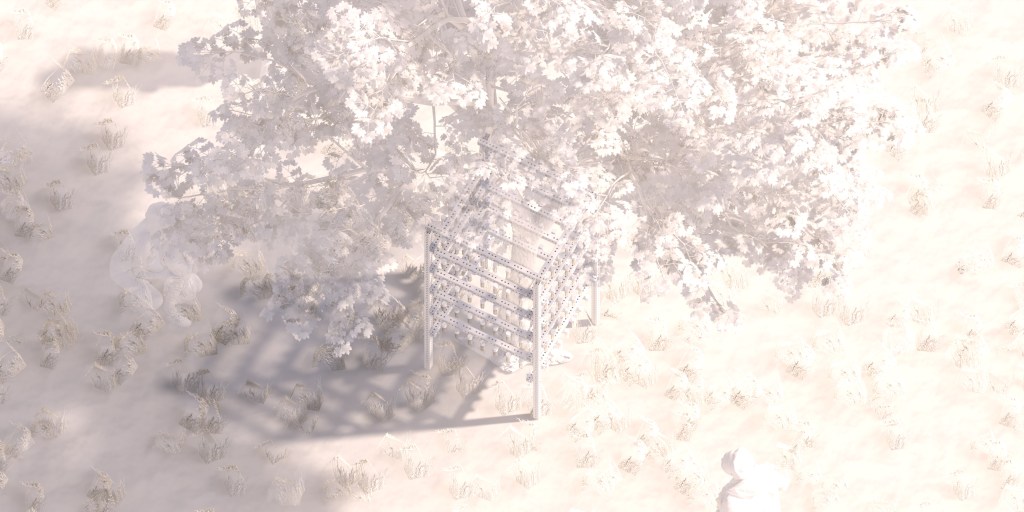
- The foregrounding of the illusory partition between “human” and “nature” through a symbolic act of transmogrification via interactive sculptural installation. (See: Transpository.)
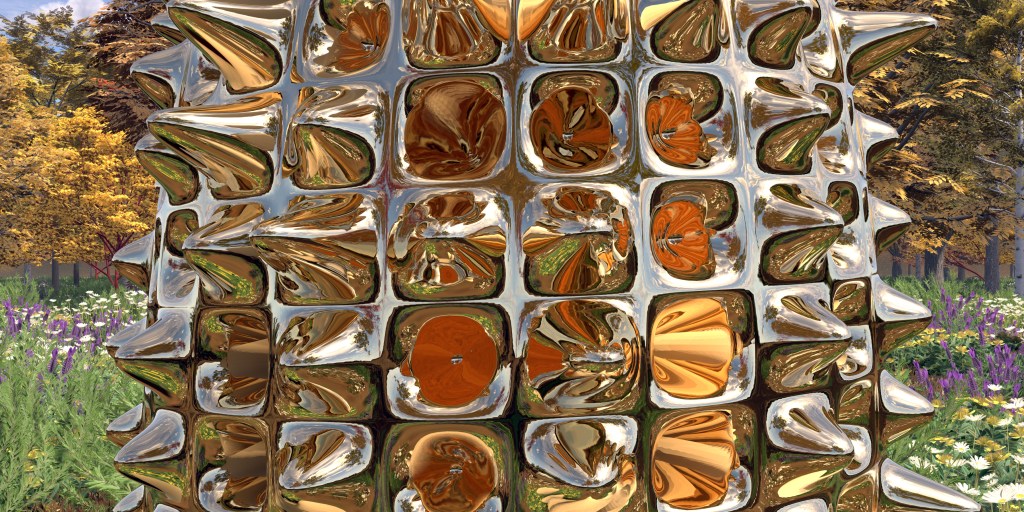
- The chimeric unification of individual, environ, and apparatus within the distorted reflection of an undulating amorphous mirrored surface. (See: Neo-Cairns.)
Our design aesthetic adapts to the diversity of our projects, and varies widely, from the commonplace and seemingly banal to the enigmatic and otherworldly. We understand the aesthetic concerns of appearance, beauty, and spectacle as downstream from — yet inextricably linked to — questions of meaning and materiality.
Continuing our self-consciously naïve fumbling for axiomatic first principles or some kind of unified theory, some relevant definitions, albeit loose:
- Human Being Design understands the disciplines of architecture3 and design2 as vehicles for exploring, expressing, and enacting the human1 condition.
- (1) We define the human as the species of animalian organism (in amalgam with its symbiotic microbiota) who has developed the language to call itself human (or who might be identified as one by another), and the technē to design and shape its condition, in a continually circular process of dialectical interchange: the human creates the design, and the design creates the human.F
- (2) We define design as the conscious — oftentimes planned — intervention between organisms — oftentimes human — and their environment.G
- (3) We define architecture as a mediative apparatus between an organism’s membranous body and their environment.H
Through a metamaterialist lens, the line between organism and environment blurs, and the disciplinary boundary of architecture widens. The organism consumes and excretes, inhales and exhales, grows and decays, builds and destroys. The organism is composed of the environ, and the environ is composed of the organism.I The line blurs between living and non-living. And so we offer end-of-life memorial planning and design services, including: funerary rites, burial and interment constructs, and artifacts of human being. We design for all phases of life, and after. We are drawn to illusive dualities, and the liminal space between face and mask, body and skin, person and position. For Human Being Design, both being [noun and verb] and design [noun and verb] — agent and agency — are inexorably intertwined. Human being [the traditional subject] and human design [the external processes and resultant object(s)] are inseparable. We are therefore, as we state upfront, a transdisciplinaryJ practice at the intersection between individual and environ.
- Please note that this is a continuously evolving internal document shared for transparency, and is not intended for persuasion or proselytization. And if you also find this text to be packed with trite clichés, and overly dense and flowery descriptions of obvious and unoriginal ideas, please know that you’re not alone.
- A. For more on metamaterialism, see:
Timur Si-Qin, “Aesthetics of Contingency: Materialism, Evolution, Art” in Stream 04 “The Paradoxes of the Living” (November 2017).
- B. Cont’d: center and periphery, inside and outside, on and off, noun and verb, thought and deed, love and hate, true and false, authentic and fake, real and ideal, and on and on and on…
- C. The modernist project blanketed the world in an ontic hierarchy whereby non-human animals, plants, organisms, and any other form of earthly matter do not hold the inherent value of the human. Within this framework, degradative categorizations like “resource”, “asset”, “commodity”, and “capital” have inevitably proliferated. Why should one care about the environment — beyond the trappings of one’s immediate surroundings and personal “property” — if its value is so diminished? This act of othering — classifying the soul-ed from the soulless, the conscious from the inanimate — is a dangerously slippery slope, and has invariably spread to the intraspecific domain of humanity, often based on artifices of religion, race, ethnicity, nationality, gender, sexuality, ability, etc. Donna Haraway,B1 Bruno Latour,B2 Mark Jarzombek,B3 and countless others have chronicled and/or warned us of the danger of this corporeal estrangement, and we are reaping the corrupt fruit in the fallout of this mindset. It is also important to note that a metamaterialist ontological system is not new, but actually quite old, and related to the epistemologies of many non-western, atavistic, and indigenous cultures around the world. It is also additionally important to say that while we reject this hierarchical framework, we do not want to throw the proverbial babies (of the Enlightenment and Modernity) out with the bath water — we wholeheartedly embrace the paradigms of scientific reasoning, and inalienable universalist rights, and cautious-yet-optimistic technological progressivism.
- C1. Donna J. Haraway, “A Cyborg Manifesto: Science, Technology, and Socialist-Feminism in the Late Twentieth Century” in Simians, Cyborgs and Women: The Reinvention of Nature (New York; Routledge, 1991, originally published in Socialist Review LXXX, 1985): 149-181.
See also: Donna J. Haraway, The Companion Species Manifesto: Dogs, People, and Significant Otherness (Chicago, IL: Publisher: Prickly Paradigm Press, 2003). - C2. Bruno Latour, trans. Catherine Porter, We Have Never Been Modern (Cambridge, MA: Harvard University Press, 1993, originally in French, 1991).
- C3. Mark Jarzombek, Digital Stockholm Syndrome in the Post-Ontological Age (Minneapolis, MN: University of Minnesota Press, 2016).
- E. The contradictions and near-impossibilities inherent to trying to work in such a way while under the duress of a profit motive and beholden to a capitalist profit motive was perhaps elucidated most powerfully by Tafuri. For more, see:
Manfredo Tafuri, trans. Barbara Luigia La Penta, Architecture and Utopia: Design and Capitalist Development (Cambridge, MA: MIT Press, 1973).
- F. For more on the circular relationship between human and design, see:
Beatriz Colomina, Mark Wigley, are we human? notes on an archaeology of design (Zürich: Lars Müller Publishers, 2016).
- G. One of the things that we love (and sometimes hate?) about design is that there’s not really anything that it can’t be ‘about’: anthropology, art, astronomy, biology, business, chemistry, cognitive development, communications, computer science, construction, cosmology, cultural studies, earth sciences, ecology, economics, education, energy systems, engineering, environment science, fashion, finance, forensics, geography, geology, history, humanities, innovation, law, linguistics, logic, management, material science, mathematics, media, medicine, modernity, music, neuroscience, performance, philosophy, photography, physics, physiology, policy, politics, psychology, public health, real estate, religion, rhetoric, sociology, statistics, technology, theater, writing… As the almost all-encompassing discipline that it is, this makes it fertile ground for exploration and experimentation for us, but also for frustration and bewilderment.
- H. For more on the membranous nature of architecture, see:
Georges Teyssot, “Architecture as Membrane” in Explorations in Architecture: Teaching, Design, Research, ed. Reto Geiser (Basel/Boston/Berlin: Birkhäuser, 2008): 166-175.
See also: Post-Mordial.
- I. An oft-cited study by Dr. Paul C. Aebersold of the Oak Ridge National Laboratory in the 1953 Annual Report of the Smithsonian Institution found that approximately 98% of the atoms of the human body are cycled out every year through cellular regeneration to be “replaced by other atoms that we take in in our air, food, and drink.” (232)
Paul C. Aebersold, “Radioisotopes – New Keys to Knowledge,” in Annual Report of the Board of Regents of the Smithsonian Institute (Washington: United States Government Printing Office, 1954): 219-240.
- J. For more on transdisciplinarity, see:
Mark Linder, “TRANSdisciplinarity” in Hunch 9 (2005): 12-15.
PROJECTS: ABODE // CABIN // SEMI-SUB-URBAN // STATION // GREEN // TRANSPOSITORY // TEA-CRETE // LIGHTS // PENDANT // RINGS // NEO-CAIRNS // VESSELS // THESES: METAMATERIALISM (Human Being) // POST-MORDIAL (MIT SMArchS) // ISOTOPIA (Syracuse BArch) // HUMANS: KRIS // JODY
© Human Being Design 2026

